
How certain do you need to be before you're willing to make a decision?
Many of us spend a considerable amount of our lives trying to work things out. We want to know whether we're pursuing the right career, whether we're making the right decisions for our children, whether we're with the right person, or whether the sacrifices we're making today will be worth it tomorrow.
And we should reflect on these things. I certainly advocate for an examined life… But there is a point at which thinking stops being helpful.
The rather cruel paradox here, is that, sometimes, the harder we try to resolve our doubt, the more doubtful we become. And rather than questioning whether our approach is working, we conclude that we simply haven't thought about it enough.
So we keep thinking.
What interests me even more, however, is what this process might be doing to our relationship with ourselves.
What if, in our attempts to establish greater certainty about our life and life choices, we're inadvertently undermining our capacity to trust ourselves?
One fear to rule them all: The fear of uncertainty
In 2016, psychologist Nicholas Carleton published a rather brilliantly titled academic paper: Fear of the Unknown: One Fear to Rule Them All?
In it, he explored the possibility that fear of the unknown might be one of our most fundamental human fears, underpinning many of the other fears and anxieties we experience throughout our lives.
It's an interesting proposition.
Consider for a moment how much of what you fear relates to something that hasn't happened yet.
When you're waiting on the results of a medical test, or wondering whether to leave a job you've been unhappy in for years, much of your distress may arise before anything has actually happened.
You really don't know what's going to happen.
From an evolutionary perspective, there is a good reason why we might find this uncomfortable. If I know what I'm dealing with, I can begin to work out how to respond. If I know where the danger is, I can prepare myself for it. If I know what to expect from someone, I can adapt my behaviour accordingly.
Knowledge gives us a degree of predictability, and predictability can provide a sense of safety.
The difficulty for our ancient brains in that many of the uncertainties we encounter today in our modern world are extraordinarily complex. They concern events that may not happen for years, decisions with countless variables, and imagined versions of ourselves living imagined versions of our lives.
Our minds have a remarkable capacity to generate these possibilities, but a much more limited capacity to determine which of them will become reality.
And for some of us, that is incredibly difficult to live with.
Intolerance of uncertainty
Uncertainty is an unavoidable feature of life.
For one person, not knowing what this year will bring is exciting. For another, it can feel terrifying. Each of us has a different relationship and tolerance for certainty.
In 2019, McEvoy and colleagues published a meta-analysis encompassing 181 studies and over 52,000 participants. They identified a substantial association between intolerance of uncertainty and symptoms across a range of psychological difficulties, including anxiety, depression, obsessive-compulsive disorder and eating disorders. More recently, a 2026 meta-analysis by Akbari and colleagues, involving nearly 29,000 participants, explored these relationships in greater detail.
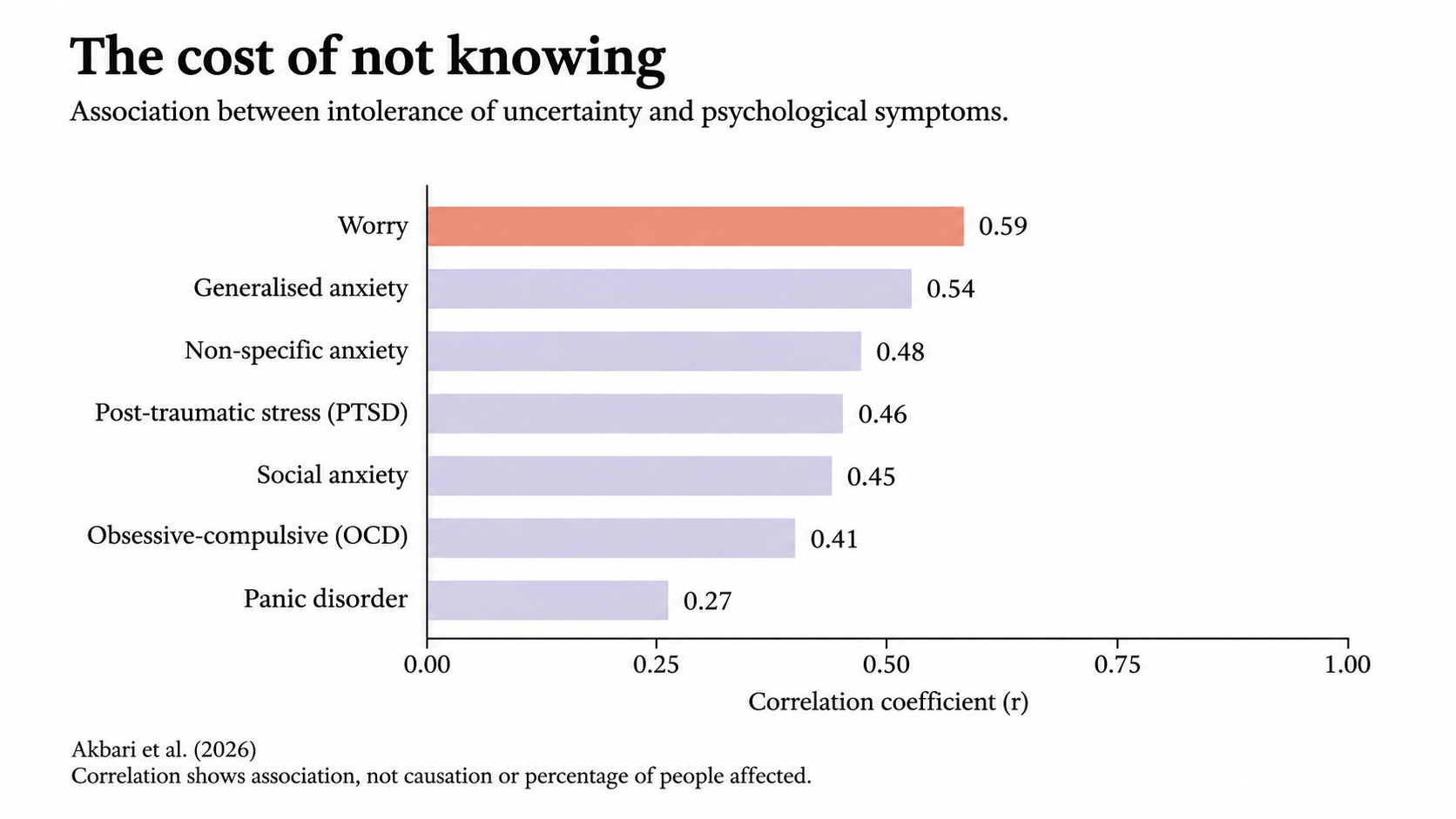
What particularly interests me about these findings is the strength of the relationship between intolerance of uncertainty and worry. The research found that worry statistically accounted for part of the relationship between intolerance of uncertainty and anxiety. Whilst this doesn't establish causation, it does invite us to consider how our attempts to manage uncertainty might contribute to the distress we're experiencing.
We tend to assume that if we could just resolve the uncertainties in our lives, we would feel less anxious.
But what if part of the problem is that we've become increasingly reliant on certainty in order to feel okay?
There is an important difference between wanting to know something and needing to know it before you can get on with your life.
The paradox of doubt: Why overthinking creates more doubt
In 2003, psychologists Marcel van den Hout and Merel Kindt, researched why people who engage in compulsive checking, as we often see in obsessive-compulsive disorder (OCD), continue to distrust their memories despite repeatedly checking something.
Let’s use the example of imagining whether you've just locked your front door.
You walk away, but a few moments later you wonder whether you actually locked it. So you go back and check.
You walk away again. Another doubt emerges. You return and check again.
Surely, the more times you check, the more certain you should become that the door is locked?
Interestingly, the researchers found the opposite. In their experiments, repeated checking reduced the vividness and detail of people's memories and undermined their confidence in those memories, despite memory accuracy remaining largely intact.
The very behaviour they were engaging in to establish certainty was contributing to their experience of doubt.
I recognise a similar pattern in much of my clinical work, especially as clients analyse major life decisions.
Someone begins questioning whether they're making the right decision. They explore the alternatives, consider different scenarios, weigh up the potential consequences and attempt to anticipate how they might feel about their decision in the future.
Initially, this might be helpful. But as the thinking continues, they become aware of more possibilities. Each possibility introduces another question. Each question introduces another potential problem.
Before long, they're considerably less certain than they were when they started.
Rather than recognise that the process of thinking might be contributing to their doubt, they interpret their doubt as evidence that they need to do more thinking.
After all, surely if it were the right decision, they would feel more certain about it?
I'm not convinced.
I think many of us have developed an unhelpful assumption that feeling certain is an indication that something is right, and that feeling doubtful is an indication that something is wrong.
The Certainty–Trust Paradox
And so, like a good psychologist, I’ve made a diagrammatic formulation on just this week’s topic. I’m calling it The Certainty–Trust Paradox.
The premise is that our attempts to eliminate uncertainty can, under certain circumstances, increase our experience of doubt, inhibit experiential learning and undermine self-trust, thereby increasing our dependence on certainty.
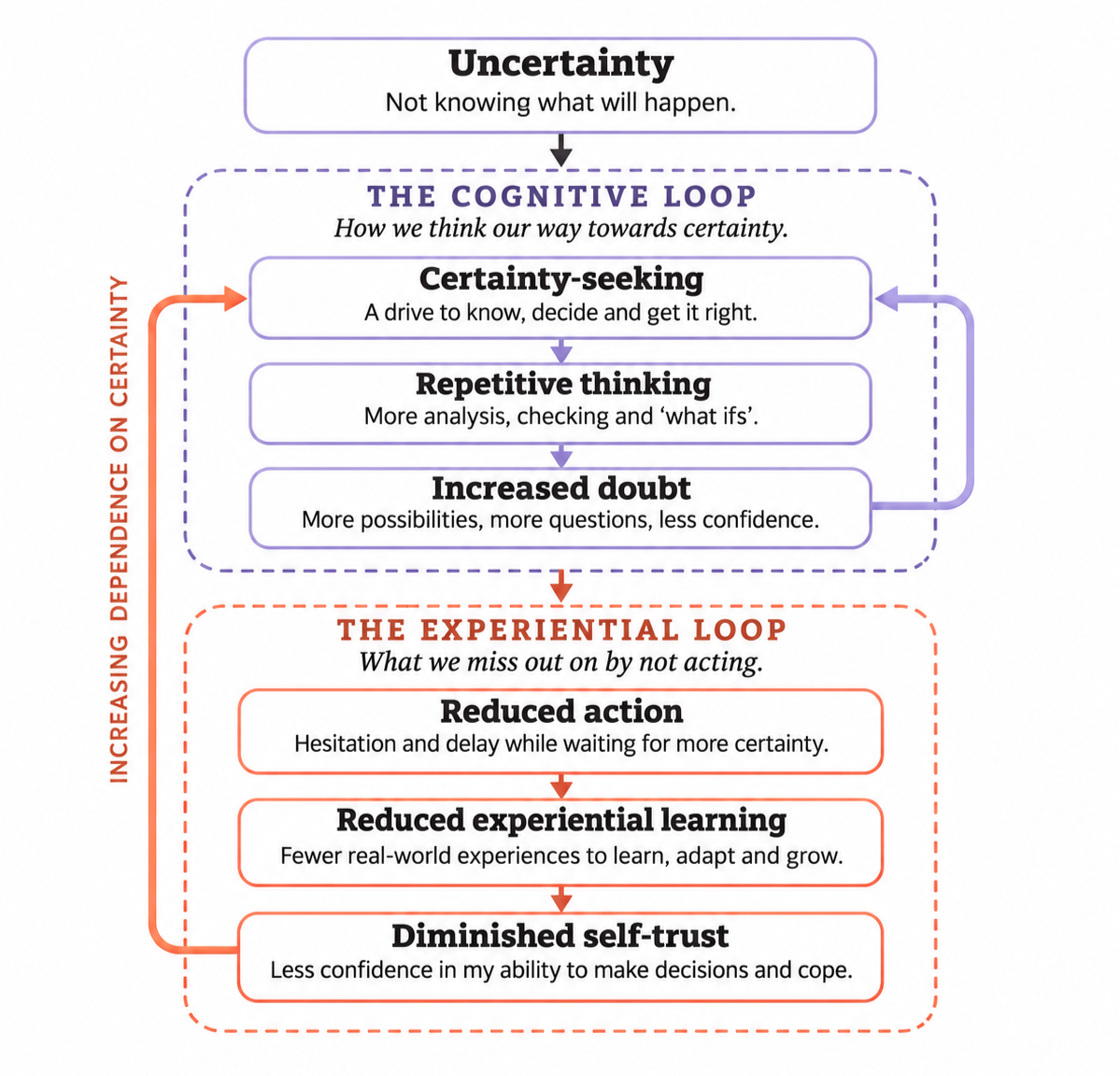
There are two interconnected psychological processes that I think are worth distinguishing: a cognitive loop and an experiential loop.
The cognitive loop
The first process concerns what happens within our minds.
We encounter uncertainty and experience it as threatening. In response, we attempt to establish certainty through further analysis, mental checking and the exploration of alternative possibilities.
But rather than arriving at a satisfactory conclusion, we become increasingly aware of the complexity of the situation.
Our confidence in our own judgement begins to diminish, which creates an even greater perceived need to establish certainty before we can proceed.
The experiential loop
The second process, is the impact on experience.
As our doubt increases, we become less inclined to act. We hesitate, postpone decisions and continue waiting for a greater degree of certainty before committing ourselves to something.
And whilst we're doing this, we're depriving ourselves of something incredibly important: experiential knowledge.
We're not discovering what it's actually like to pursue that career, have that conversation, develop that skill or take on that responsibility. We're not discovering how we respond when things go well, or how we adapt when they don't.
We're attempting to acquire knowledge about ourselves whilst avoiding many of the experiences through which that knowledge is acquired.
Psychologist Albert Bandura's work on self-efficacy is relevant here. He identified direct experiences of mastery as an important source of our beliefs about what we're capable of doing.
In other words, confidence in our abilities often develops through doing things, rather than preceding them.
I wonder whether something similar happens with self-trust.
If we continually defer decisions until we feel sufficiently certain about them, we have fewer opportunities to discover that we're capable of navigating the consequences of our decisions.
We don't accumulate the experiential evidence that might otherwise allow us to trust ourselves a little more.
And the less we trust ourselves to navigate uncertainty, the more dependent we may become on eliminating it.
And what do we do?
We think harder.
The more we depend on certainty before allowing ourselves to act, the fewer opportunities we have to discover that we can navigate uncertainty.
This is the paradox.
In attempting to establish greater psychological security through certainty, we may inadvertently be undermining another important source of psychological security: trust in ourselves.
Two ways of trusting
There’s an important distinction to be made between trusting that things will work out and trusting ourselves if they don't.
For much of our lives, we might have been trying to develop the former, without realising that what we actually need is more of the latter.
We've been trying to establish greater confidence in our predictions about the future, rather than developing greater confidence in our capacity to respond to an unpredictable future.
And these are two very different psychological pursuits.
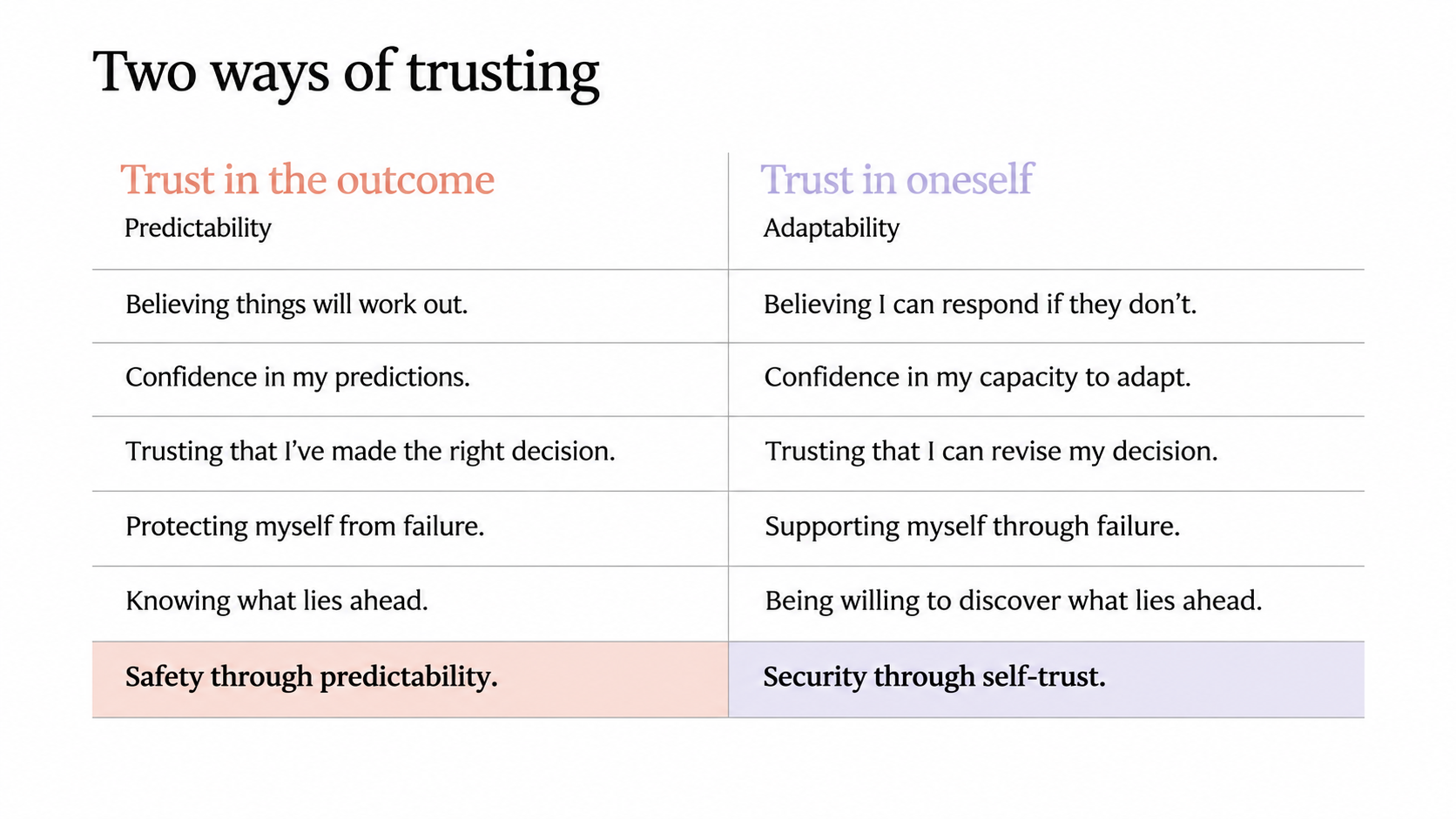
These aren't mutually exclusive. There is certainly value in having confidence in a particular outcome when we have good reason to.
But if that confidence becomes a prerequisite for action, we have placed our ability to move forward in the hands of something that will always, to some extent, remain beyond our reach… Knowledge of what is going to happen.
Learning to trust yourself amid uncertainty
The aim cannot be to rid ourselves of doubt.
There are certainly times in life when we ought to give something more thought. Some decisions have significant and irreversible consequences, and uncertainty should not be ignored.
But we need to recognise when we've reached the limits of what thinking can offer us.
When I'm caught in these patterns myself, I think there are a few questions worth asking:
Is there genuinely more information available to me, or am I going over the same information hoping it will make me feel differently?
What am I hoping to feel before I give myself permission to move forward?
What could I learn through taking a step that I cannot learn through thinking about it?
If things don't work out, what am I afraid that would mean about me?
And perhaps most importantly:
Do I know enough to take the next step, even if I don't know what the steps after that will be?
There will always be a degree of uncertainty involved in pursuing something meaningful. We cannot know with absolute certainty how a relationship will develop, what a career will become, whether a business will succeed or how we'll feel about a decision ten years from now.
We can make informed decisions. We can prepare ourselves. We can make use of the knowledge and experience available to us.
But there comes a point at which further thinking is no substitute for living.
Trust doesn't require the absence of doubt.
It requires a willingness to move forward with doubt, without all the answers.
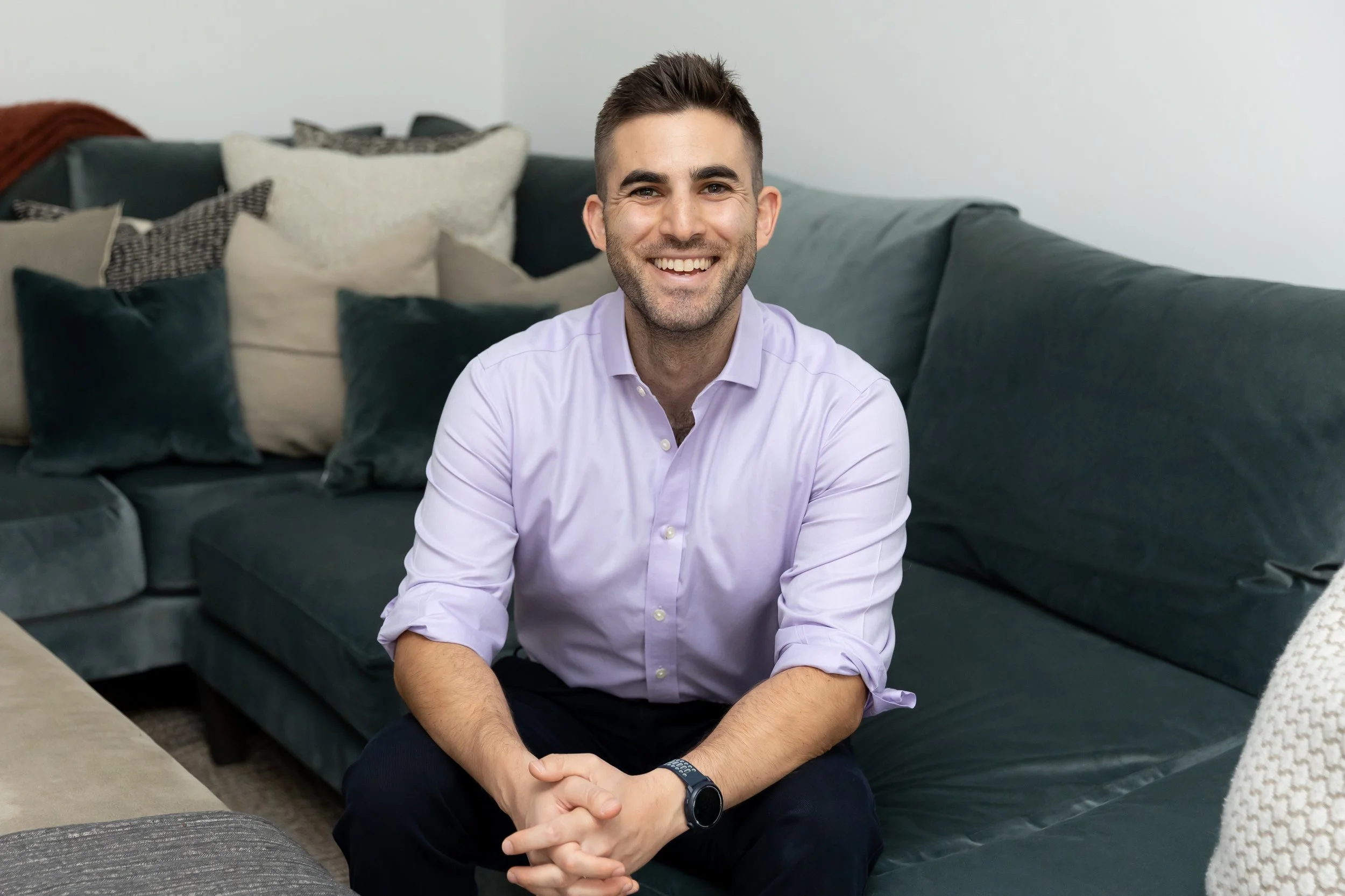
Dr Matt Slavin
Clinical & Performance Psychologist
