
On Shame pt 3: How it keeps itself alive
In the first part of this series, I wrote about what shame actually is not just an uncomfortable emotion, but a global evaluation of the self, a conclusion drawn not about what you did but about who you are.
In the second part, I traced how that develops - how a young mind, trying to hold connection together in a relational environment that couldn't always meet it, learns to locate the problem in itself rather than in its circumstances.
What I want to do now is look at what shame does once it's up and running, in real time, in the body, in behaviour, in the patterns that repeat across years and contexts and relationships, often without the person inside them having any clear sense that shame is what's driving them.
When shame arrives
One of the most consistent things I observe in the therapy room is how quickly shame moves. It arrives faster than language, and often faster than conscious awareness. Someone describes their behaviour, their "vice," or they share how they've been treated, or the moments in their life they'd rather forget and as they tell me about it, I can hear the story they've already concluded about themselves. That story is often not about the situation, but about them. The interpretation has happened before they've had time to examine it.
This makes sense once you understand what's actually happening neurobiologically. When shame activates, it engages the anterior insula and the dorsal anterior cingulate cortex, the same neural systems the brain uses to process physical pain and social exclusion. I wrote in part one about how the nursery rhyme needs rewriting, and this is the evidence for it. The brain is not distinguishing between a broken bone and a broken sense of belonging. Both register as threat. Both activate the stress response, and both send cortisol through the system and mobilise the body to manage what it has just detected.
And when the brain shifts into this threat state, your thinking brain and the regions responsible for perspective-taking, flexible thinking, clear reasoning, and considered response - become significantly less available. They go offline enough that the person in front of me, the one who is perfectly intelligent and self-aware in most moments of their life, is genuinely less able to think clearly, less able to take another person's perspective, less able to respond in a way that reflects who they actually are and what they actually value. The capacity that would help them engage constructively with whatever triggered the shame is the exact capacity that shame, in activating, impairs.
Shame doesn't organise you for growth. It organises you for protection.
And I’ll say this for emphasis - protection and growth are not the same thing.
What protection looks like
With the brain in this state, behaviour organises around a single aim: manage the exposure, reduce the threat, get through this.
Across years of doing this work, both in therapy and in performance contexts, I see that play out in three recognisable patterns. Most people have a dominant one, though context, relationship, and the specific nature of the trigger all shift which takes over.
The first is withdrawal - becoming quieter, smaller, less visible. What's driving it isn't disinterest or avoidance in the conventional sense. It's the oldest impulse that shame carries: cover yourself, reduce your exposure, get out of sight.
The second is overcompensation - working harder, performing more, trying to close the gap through effort or output. This is the one that's hardest to see because it looks, from the outside, like conscientiousness or drive. It's particularly common in the high-functioning people I work with, and for that reason it often goes unexamined the longest. But the energy underneath it isn't ambition. It's fear. The goal, often entirely outside of conscious awareness, is to make the threatening sense of inadequacy recede by producing enough to outrun it. The problem is that the distance you're trying to close isn't external. So you never quite get there.
The third is defensiveness - externalising, pushing back, locating the problem somewhere other than the self. Rather than collapsing inward, protection directs attacks outward. The self is preserved by finding fault elsewhere: in the feedback, in the person who gave it, in the situation that made it possible.
Why it becomes a loop
Each of those protective responses - withdrawal, overcompensation, defensiveness - prevents the one thing that could actually interrupt the shame experience: being genuinely seen by another person, without judgement, and remaining in connection.
Withdrawal keeps you hidden. If no one sees you in the moment that shame is running, the story you are telling about yourself goes entirely unchallenged. The only voice in the room is the shame itself.
Overcompensation keeps you defended. Whatever connection does happen occurs at the level of the performance, not the person. The underlying sense of inadequacy is never actually reached by the warmth or approval that occasionally comes from the output, because you are not letting it in at the level at which it would need to land.
Defensiveness keeps others at a distance. It works, in the short term, in the sense that it reduces the acute discomfort. But it extracts a relational cost that tends to accumulate and then, at some point, not so nicely, it erupts.
What all three share is this: they resolve the surface distress without touching what's underneath. The shame stays intact. And it often deepens, because now there is the original trigger, plus whatever the protective behaviour has cost, plus a secondary layer of self-criticism about how you responded, which becomes its own new input into the same system.
If you've worked with me you know I like to draw things out, so here's a simplified version of how the loop operates:
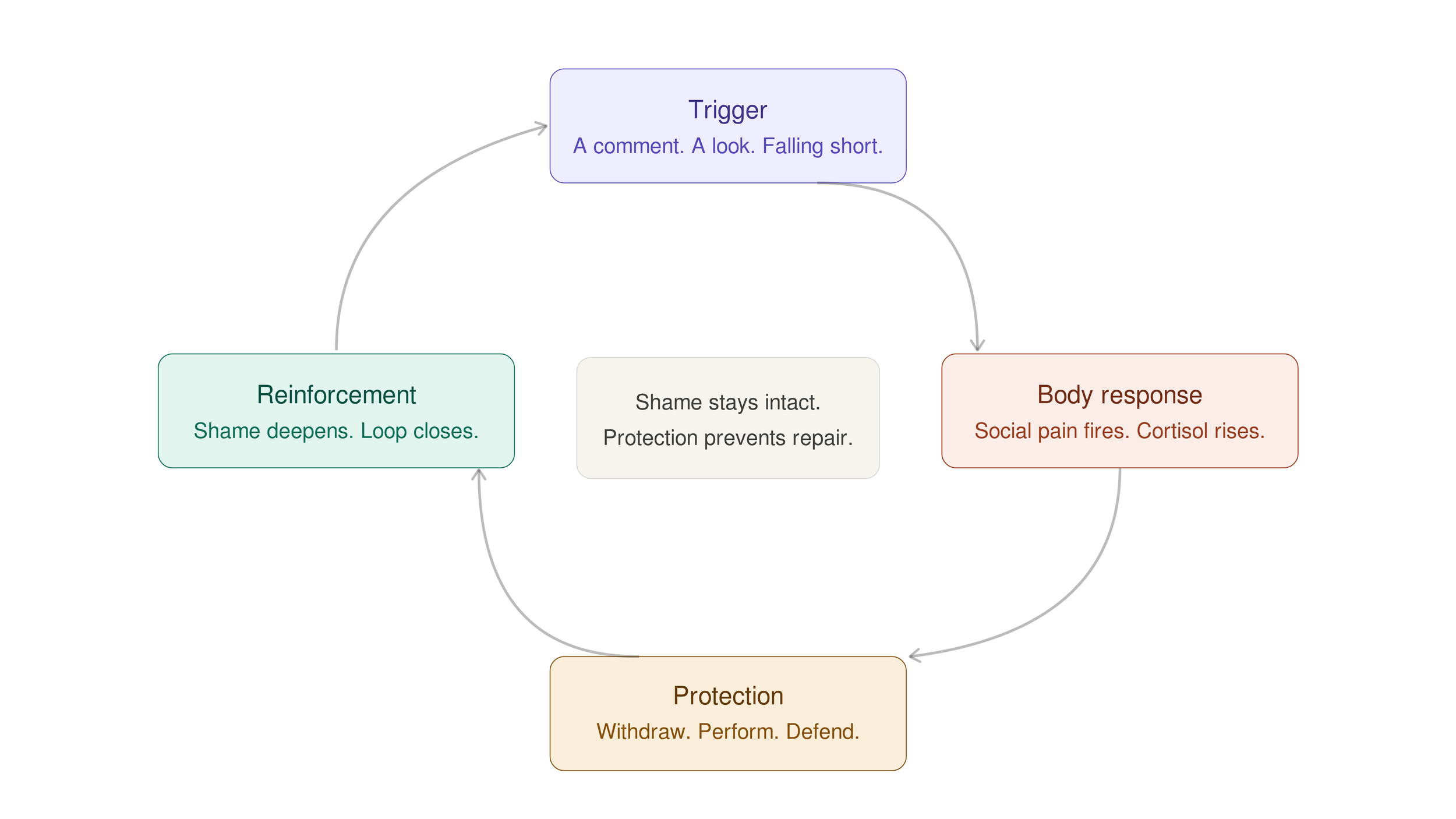
Over time this loop consolidates. The threshold for activation gets lower, and the pattern becomes more automatic. The conclusions drawn about the self become more entrenched and this is where shame starts to show up in ways that can look, on the surface, like completely separate problems.
The chronic exhaustion of someone who can never do enough.
The person who keeps their relationships at arm's length without knowing why.
The pull towards something - a drink, a substance, a behaviour, a screen - that reliably takes the edge off the internal state, even if only for a while.
These are so rarely unrelated phenomena. They are not ‘comorbidity’, they are what the loop looks like when it’s been running long enough to organise a life around it.
The thing I most want you to understand
I have met many people who are running this loop, often for years, sometimes for most of their adult lives. Highly capable people, people with genuine self-awareness, people who look completely fine from the outside and are held hostage from within.
And what I've come to believe, both from the research and from sitting with people across many years of this work is…
Shame is one of the few things that genuinely grows in the dark.
Every protective behaviour - the withdrawal, the performance, the defensiveness - keeps it there. Hidden, unexamined, untouched by anything that might contradict it.
The loop is, at its core, a darkness-maintenance system.
Which means that what interrupts it isn't insight alone, or willpower, or trying harder to be different.
It's light - the kind that comes from being genuinely seen, without judgement, and not abandoned for it.
Part four is about what it takes to bring shame into the light.
For you to reflect on
I'd invite you to notice - not to analyse, just to notice - which of the three patterns tends to show up for you when shame is running.
Withdrawal, overcompensation, or defensiveness?
Do you move between them depending on context, or is one more consistent?
And when you look at the loop as a whole - trigger, body response, protection, reinforcement - where does it feel most familiar, most automatic, most costly?
As always, there's no right answer. What matters is the looking.
Warmly,
Dr Matt

Dr Matt Slavin
Clinical & Performance Psychologist · Auckland · Online
If this resonates - for yourself, someone you love, or the people you lead - shame is one of the most common threads I work with, in therapy rooms and in organisations.
Not sure where to start? Get in touch and tell me a little about what you're navigating. I'll point you in the right direction.
