
You Are Really Good At Being Scared
You are really good at being scared.
I know that because you're reading this. Which means two things for certain: you’re alive, and you’re human.
And if you’re both of those things, then you are (by default) an expert in fear.
In fact, fear may be one of the single most important emotions in our evolutionary story. Of course, there is your personal story to take into account too, the story of your childhood, your family, your early relationships, the things you learned about safety, love, conflict, shame and belonging, but here I’m talking about a story that stretches back far beyond you, your parents, your great-grandparents, and every generation before them.
This is a story measured not in decades, but in millions and billions of years.
A few years ago, my father and I travelled to Belarus to trace our family history. It remains one of my favourite trips I have ever taken with him. We followed records back through generations and walked the footprints of our ancestors, eventually arriving at the small town where our forebears had lived. We even stood outside a family home where, in the late 1700s, my 7 x great-grandparents lived, worked, worried, loved, cooked, argued, slept, and tried, in the way we all do, to make a good life.
It was fascinating, and deeply tragic in parts, but also remarkable to feel, even briefly, in contact with my family tree.
And yet, as powerful as that felt, it barely scratched the surface of my family history.
My family tree does not stop in Belarus, nor does it in end in yet-to-be-discovered recorded history.
And neither does yours.
Your family tree connects you to every person reading this newsletter. It connects you to every human who has ever lived. Every mammal. Every bird. Every reptile. Every fish. Every living thing on this planet. If we travel back far enough, through all the branches and roots and strange evolutionary turns, we all arrive at the same place
In case you don’t know your family genealogy, here it is… your evolutionary genealogy (give it a click and explore… you’ll find us… homo sapiens on the far right).

Scientists estimate that life first emerged on Earth around 3.5 to 4 billion years ago. Long before humans. Long before mammals. Long before dinosaurs. Long before almost everything we would recognise today.
And through all of that time, one thing mattered above almost everything else.
Survival.
The creatures that survived long enough to reproduce passed on their genes. The creatures that didn’t, didn’t.
Which means that every ancestor in your unimaginably long family line had to be good at one thing.
Detecting danger.
Avoiding danger.
Responding to danger.
Your brain and body is the product of millions of years of threat detection and protection.
Which is why your brain is not primarily designed to make you happy.
It is designed to keep you alive.
Last week, I told the story of the gentleman in the bright orange shirt, and how a compliment in the park, for a brief, slightly surreal moment, transformed into a personal assault (read the full article here).
What I discussed in that article is that we do not simply hear the world as it is. We hear it through the emotional system we are residing in.
This is where I want to introduce one of the most useful psychological models I know.
It comes from Professor Paul Gilbert, the founder of Compassion Focused Therapy, and it is known as the three emotional regulation systems.
Threat.
Drive.
Soothe.
I’ll include the image of the model here, because it gives us a beautifully simple map of something that is happening inside us all day long.
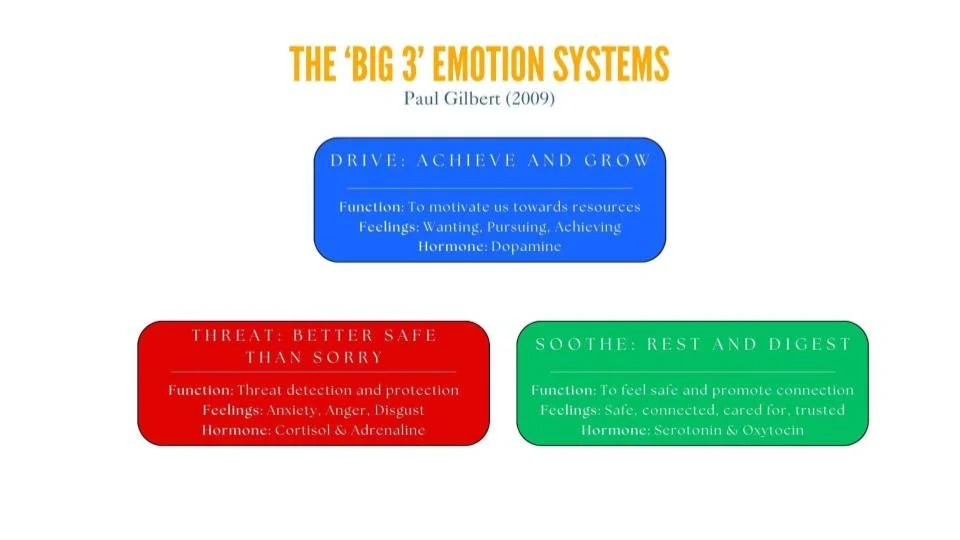
These three systems are not “good” nor “bad”. They are not personality types, and they’re not fixed boxes you live inside forever. They are emotional states you live between, depending on what your tricky brain perceives you need.
And the more clearly you can recognise which system you are in, the more choice you have over what happens next.
That, really, is the heart of emotional regulation.
The aim is for psychological flexibility.
The capacity to notice the state you are in, understand what it is trying to do for you, and then help your body and mind shift toward the state that is most useful for the moment you are actually in.
Today I’ll focus on threat… because as you’ve seen it’s something we cannot ignore, even when to try to.
Threat is what I term your ‘better-safe-than-sorry’ system. Its job is part of that evolutionary story and it’s function is threat detection and protection. It asks and reacts to questions like:
What could go wrong?
Am I safe?
Are they annoyed with me?
Am I about to fail?
Am I being judged?
Am I in trouble?
Threat by the way is fast. Really fast. Much faster than your reflective, wise, nuanced, “let’s think about this in context” mind. Threat does not sit down with a cup of tea and calmly review the evidence. Threat has evolved to react.
If there is a rustle in the bushes, threat does not say, “Let’s wait and see, so we can make a balanced decision about whether that is a tiger, rabbit, or just the wind.”
Threat says, “Move.”
For most of human history, this was wonderful equipment. The slightly too cautious ancestors probably survived. The ones who assumed everything was fine while something with teeth walked toward them were less likely to make it into the family tree.
But in modern life, this same system is often activated by things that are not immediately life-threatening, even though your body may respond as if they are.
A partner’s silence.
A child’s distress.
An email.
A disagreement.
Your body is using very old equipment (your ancient brain) to deal with very modern relational experiences.
And when you are in threat, you will usually know it somewhere in your body before you fully understand it in your mind. Your jaw may tighten or chest compress or stomach drop or breath shallows. You may become irritable, defensive, perfectionistic, avoidant, controlling, suspicious, or shut down. You may start replaying conversations, filling in the blanks, imagining what people really meant, preparing arguments you will never have, or mentally rehearsing catastrophes that have not yet happened.
Threat narrows your world.
It makes everything feel urgent, personal, and loaded with meaning.
And this brings us back to where we ended last week.
In my work, there are broadly two ways we begin changing the amount of danger, anticipation, and threat a person lives with.
One is the deep work. For when your life experiences have led you to live more often than not, in ‘threat’, experiencing the world as a scary and dangerous place.
This is the work of returning to the roots beneath our reactions. The old learning. The emotional wounds. The attachment patterns. The memories. The moments when the first learned what to expect from people, from love, from conflict, from authority, from success, from failure, from the world.
This is where approaches like EMDR can be so powerful, because they are not simply about talking ourselves into a more balanced perspective. They are about helping the brain and body update an old alarm system, and helping some deeper part of us finally realise: that was then, this is now.
But there is also the here-and-now work. If the deep work is about going down into the ocean and changing the currents that pull you, the here-and-now work is about learning how to surf the waves.
The work is not to never feel threat again. That would be a neurological miracle, and probably a very unsafe one. The work is to recognise threat when it arrives (or is arriving), and then to learn the practice of shifting your emotional state.
You create a small space between the wave and your reaction to it, and inside that space, something remarkable becomes possible.
Choice… Just enough choice to respond differently. To be less automatically governed by the first state that arrives.
So this week, my offer for you is to notice.
Notice which system you find yourself in, and what that system is trying to do for you.
Are you in threat, scanning for danger, criticism, rejection, failure, or something going wrong?
Are you in drive, moving toward goals, achievement, stimulation, progress, and the next thing to do?
Or are you in soothe, able to enjoy rest, connection, safety, warmth, or enoughness?
Let me say it again, none of these systems are “bad”. You need all three.
The skill is learning how to move between them with more awareness and flexibility.
And if you’re looking to change how you see and experience the world, or build a team that responds from a healthy dose of drive - threat - and soothe - I’d be honoured to help.
Hit reply, or click on the website links below to find out more.
Matt

Dr Matt Slavin
Clinical & Performance Psychologist · Auckland · Online
Dr Matt Slavin is a clinical and performance psychologist helping people understand human nature, and the psychology behind how we live, relate and work.
Based in Auckland, New Zealand, his work sits at the intersection of clinical psychology, performance, and leadership - helping people and teams understand how their inner state shapes the world they see, the decisions they make, and the way they respond under pressure.
Not sure where to start? Get in touch and tell me a little about what you're navigating. I'll point you in the right direction.
