
Impossible, Until It’s Not: What Rock Climbing Teaches Us About Fear, Failure, and the Limits We Invent
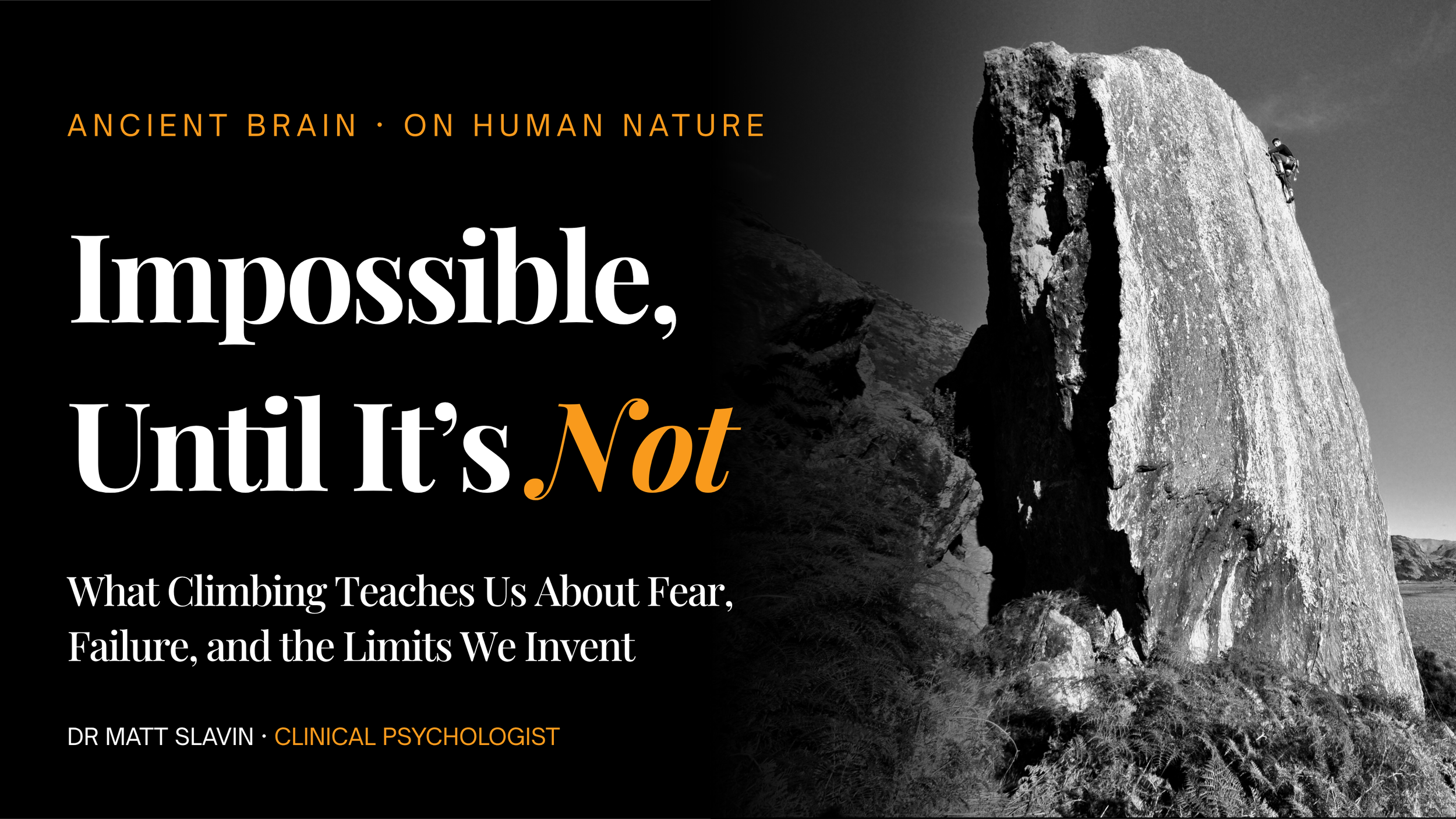
Eight weeks ago, I went back to rock climbing.
As a clinical psychologist, I spend my professional life helping people understand fear, avoidance, confidence, shame, pressure, identity and the stories they tell themselves about what is possible. I thought I understood a fair amount about these things.
Then I got back on a climbing wall, and was reminded of the difference between knowing something in your head and meeting it in your body.
Climbing was once central to my life. I climbed three or four times a week through university and my years in Edinburgh, and explored the world through rock: the Scottish Highlands, Fontainebleau, Albarracin, Wanaka. Then life changed. I moved to Southeast England to complete my clinical doctorate, to one of the flattest parts of the UK, with the nearest climbing wall an hour away. Climbing became one of those things I used to do.
Moving to New Zealand made the pull to return undeniable.
What I’ve realised, coming back after ten years, is that climbing is not simply a sport. It is a repeated encounter with the ancient brain: fear, shame, ambition, frustration, comparison, courage, play, and the confrontation of what we believe is possible.
Chosen exposure
In psychological terms, climbing is a strange form of chosen exposure.
You repeatedly place yourself in contact with fear, failure, uncertainty, embarrassment and bodily vulnerability, but in a context that is playful and, crucially, contained. The brain learns well when discomfort is real but not overwhelming; when the threat is believable but survivable; when the challenge is difficult enough to require adaptation, but not so much that your ‘thinking brain’ shuts down.
In psychology, we call this staying within the "Window of Tolerance" - not too easy, not too threatening - just enough challenge to require growth, and enough safety to stay present.
That is part of climbing’s psychological genius.
The fear is real enough that you have to pay attention. The failure is real enough that your pride gets involved. But most of the time, especially indoors, the danger is managed. There are mats, ropes, belayers, spotters, grades, warm-ups, progressions, and a whole culture of people trying very hard to do dangerous things safely.
Climbing doesn't try to remove risk altogether. It asks us to develop a relationship with risk. To assess it, prepare for it, respect it, and in a very embodied way, dance with it.
And it is a skill many of us need far beyond climbing.
Danger, risk, and discomfort are not the same thing
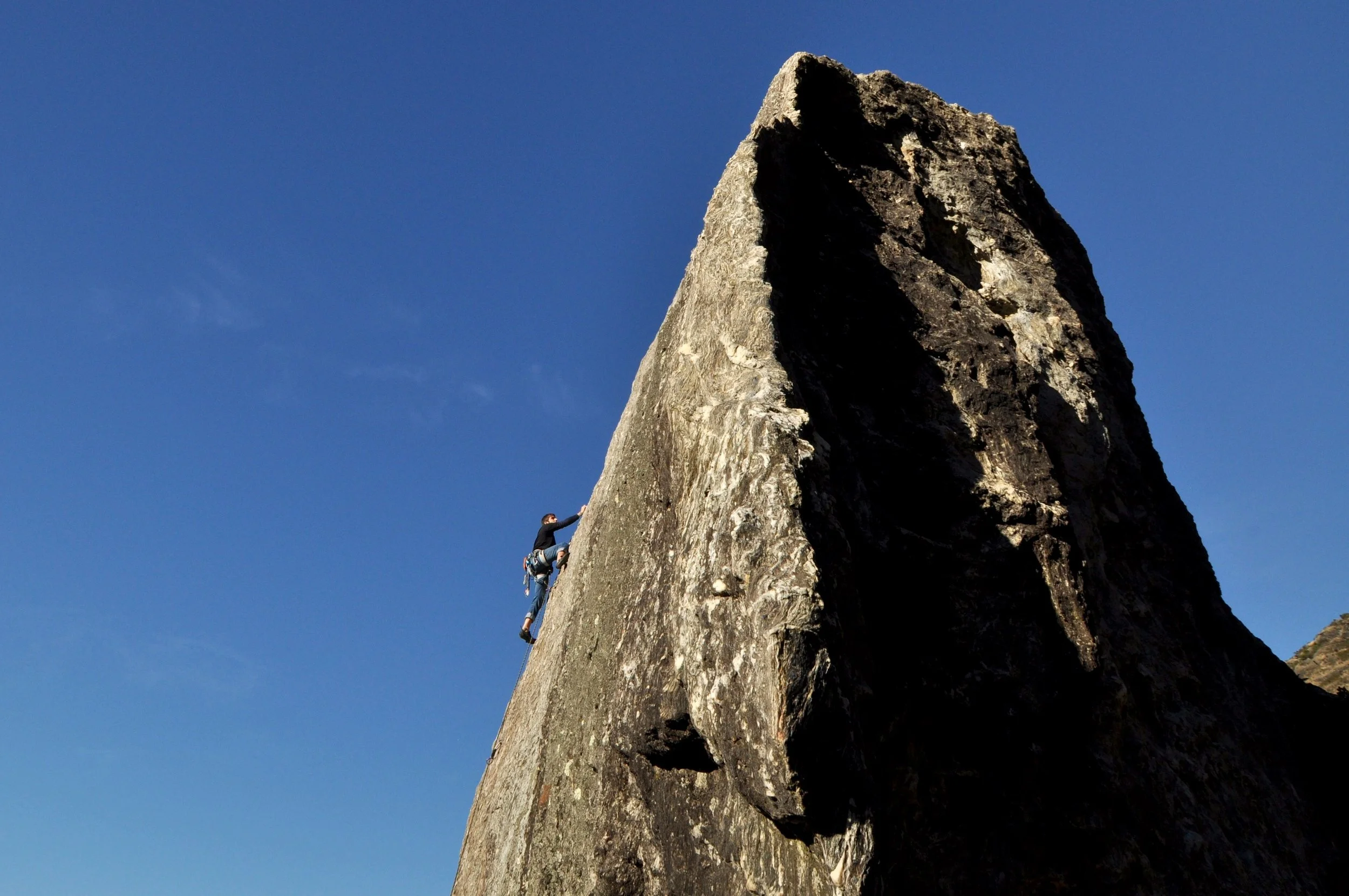
One of climbing’s great psychological lessons is learning to ask: is this actually dangerous, or is it just uncomfortable?
Those things are not the same.
Danger means there is a genuine possibility of harm that needs to be taken seriously. Risk means there is uncertainty and consequence, but it may be manageable with judgement, preparation and skill. Discomfort is the felt experience of fear, awkwardness, fatigue, exposure, embarrassment, or uncertainty.
Your rational mind may know that the mat is beneath you, the hold is safe, the rope is there, the fall is fine. But the brain's older threat-detection systems are less easily persuaded. They feel height, uncertainty, and the gaze of other people, and they say: “absolutely not”.
Climbing trains this discrimination. It asks: what is the actual risk here? What is my plan? Am I avoiding this because it is unsafe, or because I feel foolish?
In my clinical work, my role is to help people see the possible perspectives of their lived reality, and to support their decisions in how they want to act.
The capacity to pause, assess, and act deliberately - rather than react - is at the heart of good psychological functioning. Climbing asks for exactly that.
Failure is the main event
Most sports contain failure. Climbing organises itself around it.
The vast majority of time on the wall is failure: trying a move, falling, trying it differently, falling again. You adjust a foot by two centimetres, fall again. Try with more commitment, fall again. Blame your skin, blame your shoes, blame the setter, blame gravity, rest, try again, and eventually, somehow, the impossible move becomes possible.
And even when you succeed, the thrill is short-lived, because as soon as you have completed one route, you are left with the problem of the next one.
That is climbing.
And yet failure is hard-wired to be unpleasant. Even if our rational minds know there is no growth without failure, our older threat systems can still experience failure as danger, as threat, as proof that “you are not enough”.
For many of us, that response has been reinforced over a lifetime - by school, sport, work, parents, peers - all the places where learning may have been met with shame, criticism, or humiliation.
So climbing has become, for me, a kind of practice. Call it therapeutic, meditative, or a psychological intervention, it is a repeated opportunity to renegotiate my relationship with failure.
And there is no shortcut to that acquaintance.
You have to meet failure enough times, in enough different forms, for it to become familiar. You have to survive it. You have to discover that falling off a problem does not mean what some part of you fears it means.
It is also not lost on me that climbing is a completely arbitrary sport, with arbitrary rules about touching the top of an arbitrary piece of rock or plastic.
Perhaps that is part of its gift.
It lets us practise determination, ambition, frustration and disappointment in a context where the stakes feel personally meaningful, but are not, in any ultimate sense, life-or-death.
It is training, after all.
And perhaps other areas of life can be held the same way: with commitment and genuine effort, but with enough perspective to remember that many of our goals are more constructed, more arbitrary, and less catastrophic than our ancient brains would have us believe.
The hidden crux is shame
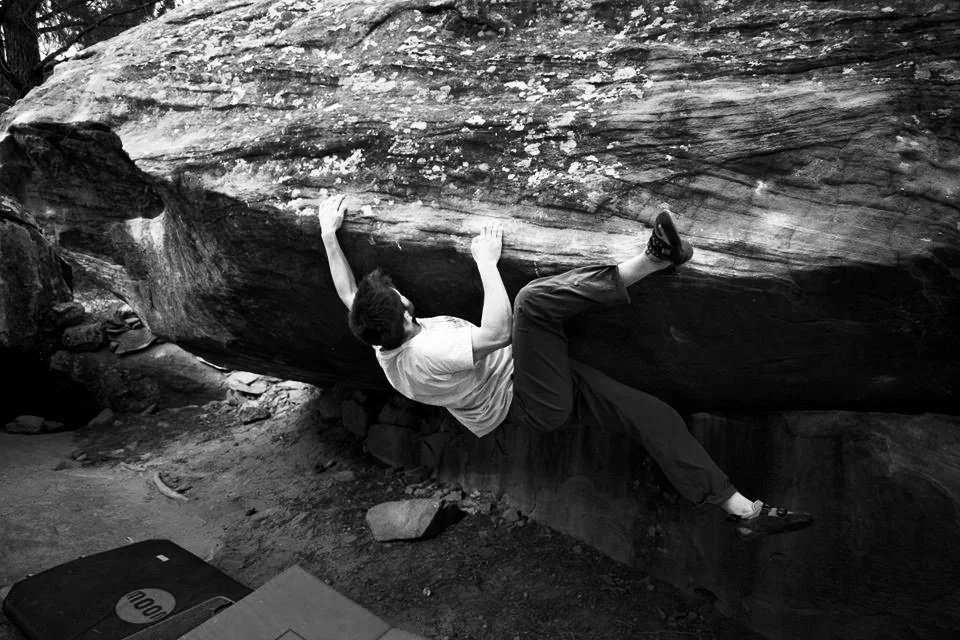
Often, the hardest part of climbing is not falling.
It is falling while being watched.
It is trying something that makes you look weak, scared, stiff, uncoordinated or foolish. It is being seen before you are competent.
And this exposes one of the great barriers to growth: not our lack of ability, but our fear of what it means to be seen while still learning.
Most of us do not only fear failure. We fear what failure might seem to say about us.
That we are not talented, not strong, not brave, not as good as the people around us… not as good as the person we used to be.
That last one has been especially present for me. Returning to climbing after ten years easily invites comparison with a former self. That comparison can be painful. But it can also be an invitation: not to reclaim a former self, but to meet an old part of yourself from a new place.
From impossible to possible
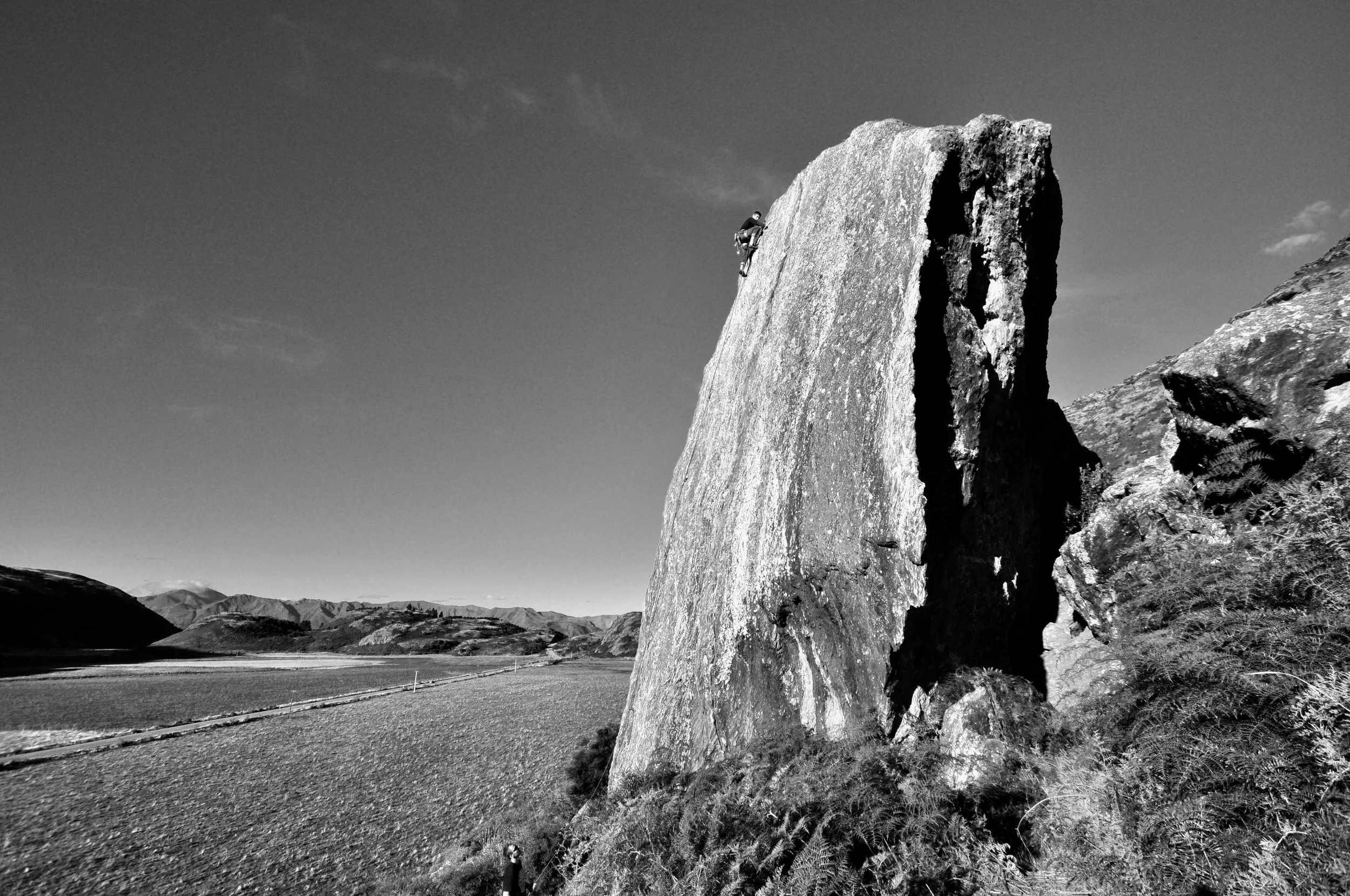
There are routes I have stood beneath and genuinely could not picture doing.
I’m not talking about self-doubt, I mean a total absence of any internal image of success. No internal model of how it could happen.
What climbing has shown me, repeatedly, is that the only way past that is to stay open to the possibility of possible. It cultivates an openness to say: perhaps this is not impossible. Perhaps I simply cannot yet imagine the solution.
The brain is constantly predicting what we can and cannot do. It’s part of its architecture. If we have repeatedly experienced ourselves as capable, supported and able to recover from mistakes, it is more likely to predict possibility. If we have repeatedly experienced criticism, humiliation or failure that felt unbearable, it becomes primed to predict defeat. The brain learns to expect the world it has lived in.
But it can also keep learning.
When you do a move that your whole body had filed under impossible, the brain receives new evidence. Reality contradicts the prediction, and something in your wiring has to update.
One day, often sooner than expected, you find yourself doing a movement that previously had no place in your imagination. And then the brain does what all our brains do.
It says: “oh, that wasn’t so hard”
It revises the memory almost instantly.
But if you can hold onto what it actually felt like to stand at the bottom and see nothing - no way ahead - and pair that with the later experience of doing the move, your brain starts to build a different template:
Things that feel impossible now are not necessarily impossible at all. Sometimes they are simply not possible yet.
Dormant Selves
For ten years, climbing was largely absent from my life. I often tried to return to it, but my life had other priorities.
You simply cannot do everything you want, all at once.
I have said this to clients many times, especially those navigating parenthood, career-building, caregiving, relocation, illness, grief, or the sheer density of adult life. There is a real grief in wanting to be many things simultaneously and realising that you cannot.
You may want to be the devoted parent, the ambitious professional, the adventurous friend, the strong climber, the present partner, the person who reads, trains, sleeps, cooks, contributes, rests, and keeps a tidy garage.
But life does not usually allow all selves to be fully expressed at the same time.
We are allowed to have dormant selves. Parts of us that go quiet for a while, because another part of life has needed the space.
That is how climbing feels to me at the moment: a re-acquaintance with an old friend.
I am older now, stiffer and more tired in some places, perhaps stronger in others, and carrying a great deal more life than I was then.
And perhaps this is true of many things we return to. The guitar left in the corner. The half-written book. The friendship that distance separated you from. The place that made you feel alive. The version of yourself that needed to take a back seat, while another part took the steering wheel.
Sometimes growth does not look like becoming someone entirely new. Sometimes it looks like making room for a part of yourself that has been patiently waiting.
So, What Is Your Version of This?
So I ask you: what is your version of this?
Where are you meeting failure at the moment, and what kind of relationship are you building with it?
Where are you learning to distinguish danger from discomfort?
What feels impossible right now, and what might shift if you stayed open to the idea that it simply is not possible yet?
And what dormant part of yourself might be waiting to be welcomed back?
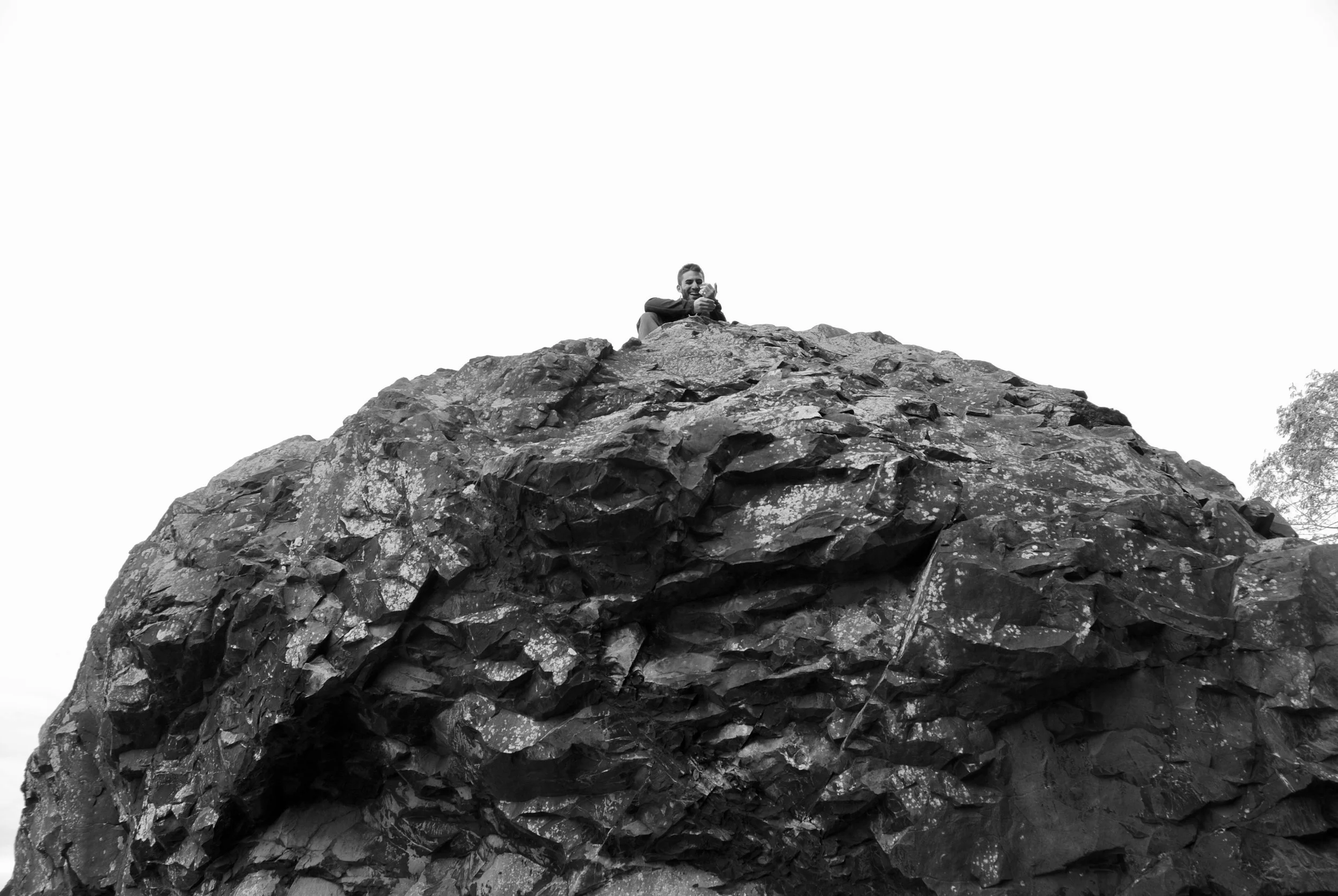

Dr Matt Slavin
Clinical & Performance Psychologist
Auckland · Online
If this resonates - whether you're a climber or not - and you'd like to explore this work personally, or have me speak on the psychology of performance, failure, and growth, I'd love to hear from you.
Not sure where to start? Get in touch and tell me a little about what you're navigating. I'll point you in the right direction.
