
Why Your Mind Won't Shut Off at Night (Even When You're Exhausted)
It's 3am. You're wide awake. Your body is desperate for sleep, but your mind has decided now is the perfect time to start work. It’s sorting through unfinished tasks, unresolved worries, future problems, and anything else it can draw into the room.
Sound familiar? If you've been there - staring at the ceiling while your thoughts get busier and busier - this article is for you. It's about the psychology of sleep: why your mind wakes up when your body needs it to switch off, and what genuinely helps.
If you have 10 seconds to get the essence of this article, before we get into the why: this isn't really about sleep at all. It's about arousal, interpretation and safety. Your body at 3am is usually tired enough for sleep. What typically is happening is that part of your brain has stayed online, alert and problem-solving, even though the rest of you is ready to sleep.
First, you should know that waking briefly in the night is normal. Everyone does it. Most people just don't remember it, because nothing much happens next. But if, in that waking moment, your mind catches on a worry, a concern, or something you still need to do, then your brain obligingly, and unhelpfully, does exactly what it's built to do when it senses a problem. It gets more alert. Which is the last thing anyone needs at 3am
So before we talk about stress, worry, rumination, trauma, or what to actually do when this happens, it helps to understand one simple thing: waking in the night is not, by itself, a sign that something has gone wrong.
Sleep Isn't One Long, Uniform State
Normal sleep moves in cycles. Across the night, the brain shifts between lighter non-REM sleep, deeper non-REM sleep and REM sleep - the stage most linked to vivid dreaming and emotional processing
Deep sleep tends to cluster earlier in the night. REM sleep gets more prominent later. Which means the second half of the night is naturally more dream-heavy, more emotionally active, and closer to waking.
So if you wake at 3am, it does not automatically mean anything is wrong. Your brain may simply have drifted closer to wakefulness as part of a normal sleep cycle.
The problem often begins one step later, when that waking moment becomes a problem your brain thinks it has to solve:
"I'm awake" → "Why am I awake?" → "What’s on my mind?" → "Ah, that thing" → "I need to sort this out now"
And there it is again: your brain, obligingly and unhelpfully, doing exactly what it does when it senses a problem. It scans for information, hooks onto a worry, and starts trying to regain control.
Which would be useful almost anywhere else. But at 3am, problem-solving isn't a sleep state. It's the opposite of one.

Why 3am Is Such Fertile Ground for Worry
There is a biological rhythm to night waking. Your sleep is shaped by two major systems: your circadian rhythm, which is your body’s roughly 24-hour clock, strongly influenced by light, and sleep pressure, which is the drive to sleep that builds the longer you have been awake.
On a good night, those two systems work together. Your body knows it is night, your sleep pressure is high enough, and your brain can move through its cycles without much interference.
But there is a third factor that matters enormously: whether your threat system feels settled enough to permit rest.
You can be genuinely exhausted and still feel wired. You can nod off on the sofa at 9pm, then get into bed and suddenly feel wide awake. You can have plenty of sleep pressure in your body, but still have a brain that does not feel ready to wind down.
If you are under chronic stress, grieving, processing something difficult, dealing with uncertainty, or going to bed already wound up, the later hours can become fertile ground for vivid dreams, emotional fragments, threat-based thoughts and sudden jolts of alertness.
Admittedly, sometimes you will wake because of caffeine, alcohol, heat, pain, hormones, a snoring partner, a child calling out, or your bladder calling for attention.
But when 3am waking becomes routine, and is accompanied by racing thoughts, dread, or panic it is worth looking psychologically as well as practically.
Why Stress Gets Louder at Night
Plenty of people whose minds will not switch off at night manage extremely well during the day. They work, parent, answer emails, make decisions, manage other people, and do all the things life asks of them.
During the day, your attention has scaffolding to lean on: tasks, roles, deadlines, other people’s needs, and you can be held in place by the structure of the day.
At night, that scaffolding disappears, and stress reaches sleep through two doors.
One is cognitive arousal: thinking, planning, replaying, anticipating, rehearsing, problem-solving.
The other is physiological arousal: muscle tension, a faster heart rate, shallow breathing, cortisol, adrenaline.
And this is where the 3am mind can become so convincing.
A problem that feels manageable at 2pm can feel enormous at 3am. Tired, and alone, you have few resources available.
So the mind reaches for one of the tools it still has available: rumination.
Rumination can feel useful because it looks a bit like preparation. You replay the conversation so you will know what to say. You rehearse the risk so you will not be caught off guard. You run the scenario again so you can feel more certain.
But rehearsal is not resolution.
Running the same worry for the fortieth time does not usually solve it. It keeps the worry active. And once the mind feels unsure, it often tries to get certainty by replaying the whole thing again.
That is why the middle of the night is almost never the best time to solve a complex relational, financial, professional or existential problem, however convincing it feels in the moment.
At 3am, the task is rarely to solve your life.
More often, the task is to help your body feel safe enough to sleep.
When Sleep Itself Feels Unsafe
For some people, this is the centre of it.
Sleep asks something quite vulnerable of us: a temporary surrender of control.
If your nervous system has learned, over time, that the world is broadly safe, that surrender feels ordinary, and pleasant.
But if you have lived through trauma, unpredictability, unsafe relationships, years of sustained stress - long periods where you had to stay alert to get by - that same surrender can feel like danger.
So part of you stays ‘on duty’, it stays alert, it remains vigilant, ‘hypervigilant’ even.
Hypervigilance is the mind and body staying ready, just in case. It is almost always an intelligent adaptation to a time when being relaxed, unaware, or unprepared carried real threat.
The difficulty is that your threat system can keep running long after the original danger has passed.
So at night, when the world goes quiet and there is nowhere else for attention to go, part of the brain may stay on watch, listening for danger, because it has learned that fully letting go is not a safe thing to do.
When sleep feels unsafe, advice that only focuses on habits - less caffeine, fewer screens, a darker room - can miss the heart of the problem. Those things may help, of course. But if part of your brain is still trying to protect you, the path to better sleep is helping your body learn that rest is safe enough to risk.
What Actually Helps When Your Mind Wakes Up at Night
The goal here is not to defeat your mind, silence every thought, or win an argument with your own brain at 3am. Nobody wins that argument. The harder you try to solve, argue or analyse, the more awake you often become. The aim is to lower the level of arousal, and help your body feel safe enough to let sleep return.
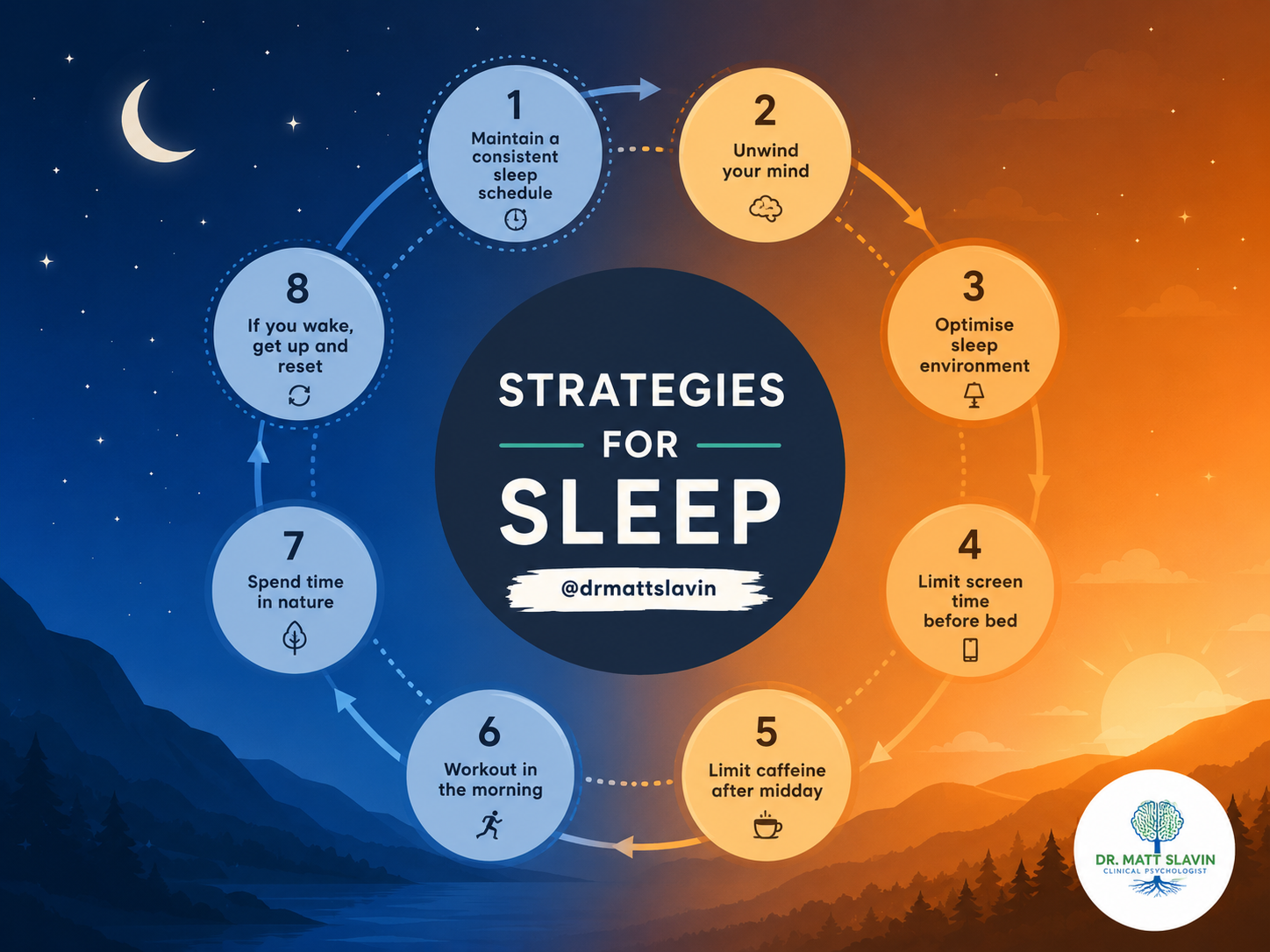
1. Stop trying to force it. Trying to force sleep increases monitoring, and monitoring increases arousal. It's self-defeating by design, and the harder you try, the more awake you feel.
2. Keep the lights low and the world small. Bright light, emails, news, social media, work messages, all of it tells your brain the day has started. At 3am, the aim is to give your brain as little evidence as possible that this is a time for action.
3. Use a "not now" response to racing thoughts. You don't have to win the argument, and you don't need an empty mind. Just acknowledge the thought and set it down (or better write it down and close the notepad): "I see you. I hear you. Now now. We’ll come back to this tomorrow."
4. Ground yourself instead of arguing with yourself. Anxiety isn't only a thinking problem, it's a body-state problem. So rather than trying to reason your way out of it, bring attention back to the body: the weight of yourself on the mattress, the feeling of the duvet, the sounds in the room, the contact of your feet or hands.
5. Help the body stand down. Slow, exhale-focused breathing, progressive muscle relaxation, can all send the same message: nothing needs to be solved right now.
6. Get out of bed if bed has turned into a battleground. Not every waking needs action. But if you are lying there wide awake, frustrated and increasingly alert, the struggle itself can become part of what “bed” means. Get up, keep the lights low, do something quiet and boring, and return when you feel sleepy again.
7. Deal with worry before bed, not in it. If your mind keeps waking you with unfinished loops, give worry an earlier appointment. Set a time earlier in the day as ‘worry time’, where you get to write down what is on your mind, what can wait, and any small next step.
8. Build sleep from the morning onward. Sleep isn't shaped in the hour before bed, it's shaped across the whole day. Morning light, movement, when you had your last coffee, alcohol, stress, screens, routine, and genuine downtime all influence how easily your body winds down later.
When to Seek Help
Occasional bad nights are normal, through stress, illness, grief, parenting, hormonal change, travel, big life transitions. Nobody sleeps perfectly all the time.
But it's worth reaching out for support if this is a persistent pattern, if you find yourself dreading bedtime, if night waking is affecting your mood, work, parenting, or relationships. If you regularly wake with racing thoughts, or if panic or nightmares or traumatic memories are involved, you don't have to earn the right to ask for help by suffering long enough first.
Better Sleep, Better You
If any of this rang true for you, I've put together a free companion guide:
Better Sleep, Better You A Practical Guide to Winding Down and Waking Well.
It's a short, practical guide covering why sleep can feel so elusive, how stress and night-time activation affect rest, and what to actually do when your mind wakes up at night, including tools for winding down, managing racing thoughts, responding to night-time activation, using grounding strategies, and building a daily rhythm that helps your brain and body feel safe enough to let go.
Send me a message asking for "Better Sleep, Better You" and I'll send it over.

Dr Matt Slavin
Clinical Psychologist
New Zealand · Online
Not sure where to start? Get in touch and tell me a little about what you're navigating. I'll point you in the right direction.
